
BUY MOVE-IN READY OR RENOVATE? WHAT NEW YORK BUYERS SHOULD KNOW
When most people begin searching for a new home in New York, the process often focuses on square footage, layout, or the right neighborhood. What to do with the space once it is theirs frequently comes later, if it comes up at all.
Yet the decision between purchasing a move-in ready home and taking on a property that needs work is one worth addressing before the search begins. Both paths have merit, but both involve trade-offs that are easy to underestimate. In Brooklyn and Manhattan, the difference is rarely as straightforward as it appears on paper.
Let’s break down the considerations, drawing on what we’ve observed working with clients across both scenarios.
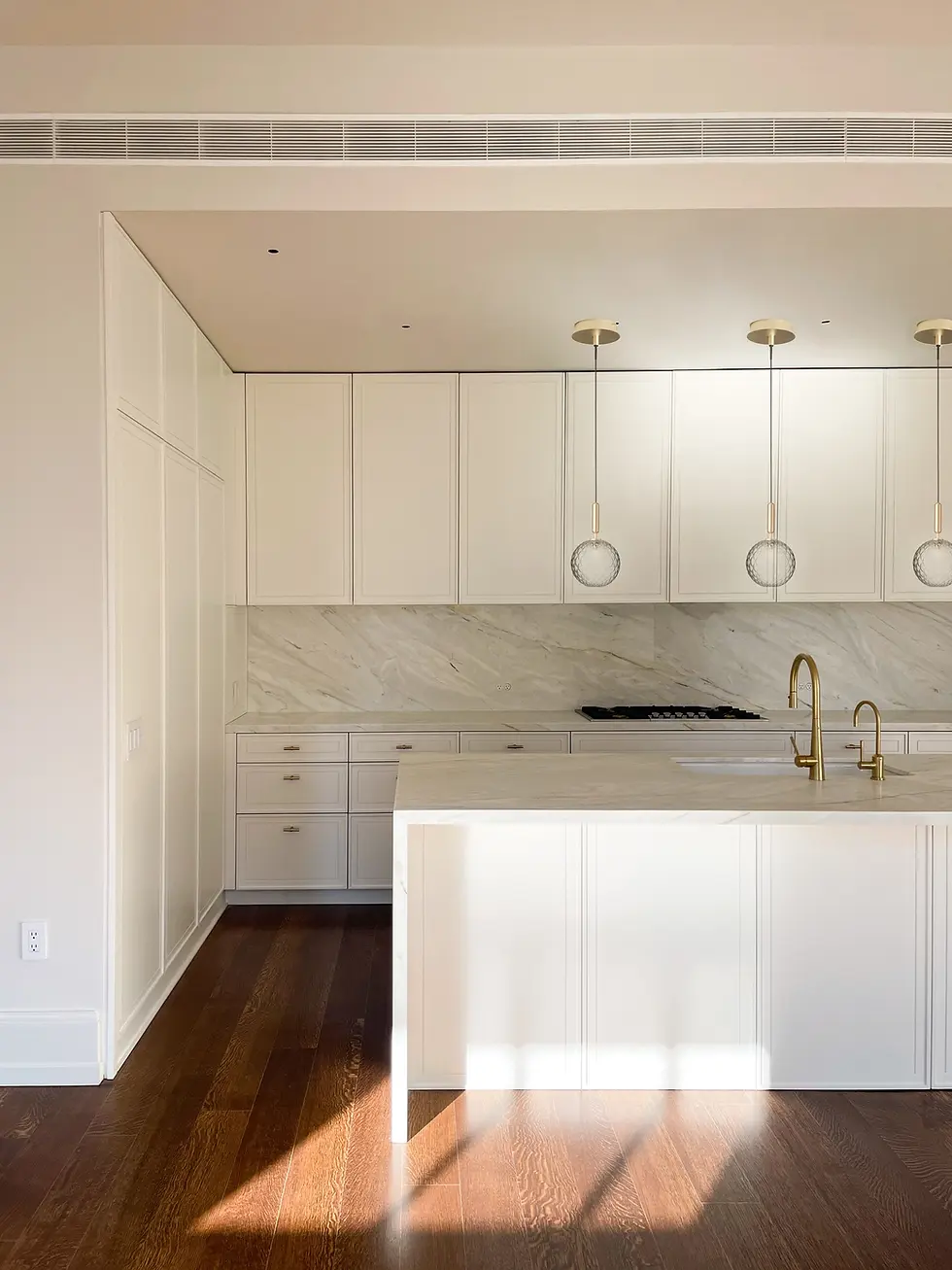
The Appeal of a Move-In Ready Home
The most immediate advantage of a move-in ready house is time. There is no gap between purchase and occupancy, no period spent managing contractors or making high-stakes decisions under pressure, and no temporary living arrangements to navigate. For buyers with limited flexibility or those who have already endured a lengthy search, the ability to move in immediately is valuable.
Move-in ready, however, does not always mean it's the right decision. Many developments in Brooklyn and Manhattan are designed for a generalized buyer. Layouts function, finishes are acceptable, and design decisions reflect broad market appeal rather than individual lifestyles.
The result is often a home that is comfortable enough, but not precisely attuned to how you live.
Renovation is most rewarding when it bridges the gap between what works and what is truly tailored to you.
What a Renovation Can Offer
Purchasing a property in need of work is fundamentally a case for specificity. Renovation allows a home to be shaped around your actual life: morning routines, work habits, entertaining, kitchen use, storage needs, and even the quality and orientation of light. Developers cannot make these choices on your behalf, as they do not know you.
Homes designed and built with a specific client in mind read differently than those finished to a market standard. The distinction is seen and experienced.
A DEVELOPER CANNOT MAKE THOSE DECISIONS ON YOUR BEHALF, BECAUSE THEY DO NOT KNOW YOU.
The trade-off is patience and tolerance for uncertainty. A renovation in New York requires careful decision-making under conditions that may feel uncomfortable, from structural surprises to long lead times. For those prepared for the process, the results are profoundly rewarding; for others, it can feel like a prolonged disruption. The question worth asking early is honestly: how much ambition do I have for this project, and how much patience am I willing to bring?
A Question of Quality
Another distinction buyers often overlook is the difference in quality between a developer-built property and one renovated for a specific client. Developers work to a different brief: they optimize for what photographs well, what can be completed within a margin, and what will sell broadly. Contractors renovating for a specific client are accountable to the buyer’s standards, which are typically higher and harder to obscure.
The difference shows in the details: well-made casing, correctly installed millwork, plumbing and electrical work done to last rather than to pass inspection. These are qualities that a buyer may not fully assess in a walkthrough, but which become evident over time.
When we accompany clients on property searches, we focus on these details—what has been done carefully, what shortcuts were taken, and what could become a problem later. This perspective reshapes how a property’s value and potential are understood.
Customizing a New Development
There is also a middle path: buying a unit in a new development and making it truly your own. This can be effective when the apartment’s bones are strong but the finishes feel impersonal.
Our Pacific Penthouse project in Brooklyn is a prime example. The clients purchased a new development unit and came to us wanting a home that felt custom. Through bespoke millwork, integrated workstations, thoughtful materials, and a considered palette of wood, plaster, and natural finishes, the apartment became fully personalized. Light plays intentionally across surfaces, and every detail signals care rather than efficiency. The end result no longer reads as a developer unit—it reads as a home.
This approach addresses the central limitation of many new developments: they are designed for everyone, which often means they are designed for no one in particular. Thoughtful design layers a personal touch without the scope of a full gut renovation.
Resale Value and the Case for Timeless Design
The conversation around resale often frames renovation as risky: will a custom investment appeal to future buyers? Will the choices made for one owner translate to market value?
In our experience, the greater risk lies in trend-driven finishes and design that are clearly of their moment. What endures and what appeals to future buyers is quality, restraint, and attention to detail: proportioned rooms, millwork that fits correctly, and a considered palette that reads as timeless.
Our philosophy is consistent across projects: create homes that do not age quickly, function well for contemporary living, and convey care and thoughtfulness to anyone who steps inside, today or in the future.
Finding the Balance in Home Renovation
Not every property in need of work calls for a full gut renovation, and not every buyer is suited to that approach. The scope depends on a few key factors: whether the existing layout works for your life, the condition of the infrastructure, and how much intervention is needed to make the space feel right rather than merely acceptable.
Full renovations are appropriate when flow, room placement, or infrastructure are fundamentally misaligned with how you want to live. Focused interventions like updating cabinetry, lighting, and finishes, work when the bones are strong and the challenge is character rather than function. The Pacific Penthouse fell into this category: spatially sound, it simply needed a thoughtful overlay to feel like the clients’ home.
Clarity on scope early in the process saves time, aligns expectations, and informs budget and timeline planning.
Getting Guidance Before You Buy
A designer’s early insight can be invaluable. Walking through a property before purchase, especially a brownstone in Brooklyn or pre-war apartment in Manhattan, allows buyers to understand what a space could become, the constraints it carries, and the effort required to reach the desired outcome.
This approach shifts the search from “what already looks right” to “what has the right structure and potential,” making it far easier to identify properties with genuine possibilities. In a market where move-in ready homes of exceptional quality are rare, this perspective is particularly useful.
Deciding Between a Move-in Ready Home or a Renovation project in Brooklyn or Manhattan?
Studio Ocra is a full-service interior design studio working across Brooklyn, Manhattan. Whether you are weighing a move-in ready purchase against a renovation, or evaluating a property’s potential, we provide early guidance to help you make informed, confident decisions.
Get in touch to talk through your project, or explore our services to learn more about how we work.


Comments