
DESIGNING KITCHENS IN BROOKLYN AND MANHATTAN
In kitchen interior design across Brooklyn and Manhattan, many clients arrive with the sense that their kitchen works, but doesn’t belong. It may be efficient on paper, yet visually disconnected from the rest of the home. Or it may feel considered in appearance, but compromised in everyday use.
At Studio Ocra, we reject the idea that these two conditions should be separated. A kitchen is not required to choose between beauty and function—it should hold both with equal clarity. It is one of the most visible rooms in the home, often open to living and dining spaces, and it deserves to be treated as such.
THE MOST SUCCESSFUL KITCHENS ARE NOT HIDDEN SYSTEMS OR OVERLY EXPRESSIVE STATEMENTS. THEY ARE COMPOSED SPACES WHERE MATERIAL, PROPORTION, AND USE EXIST IN BALANCE.

A Room Defined by How it is Seen and Experienced
Every kitchen begins with an understanding of how it sits within the home visually as much as how it operates.
In Brooklyn and Manhattan apartments, kitchens are rarely enclosed. They are part of a continuous interior landscape, seen from multiple angles throughout the day. This requires a level of control over material, alignment, and proportion that extends beyond pure functionality.
At the same time, the kitchen remains deeply personal. It is where people cook, gather. The design must hold both presence and ease without prioritising one over the other.
Concealment, Clarity and Architectural Order
A consistent principle in our kitchen interior design approach is the idea of visual restraint through integration.
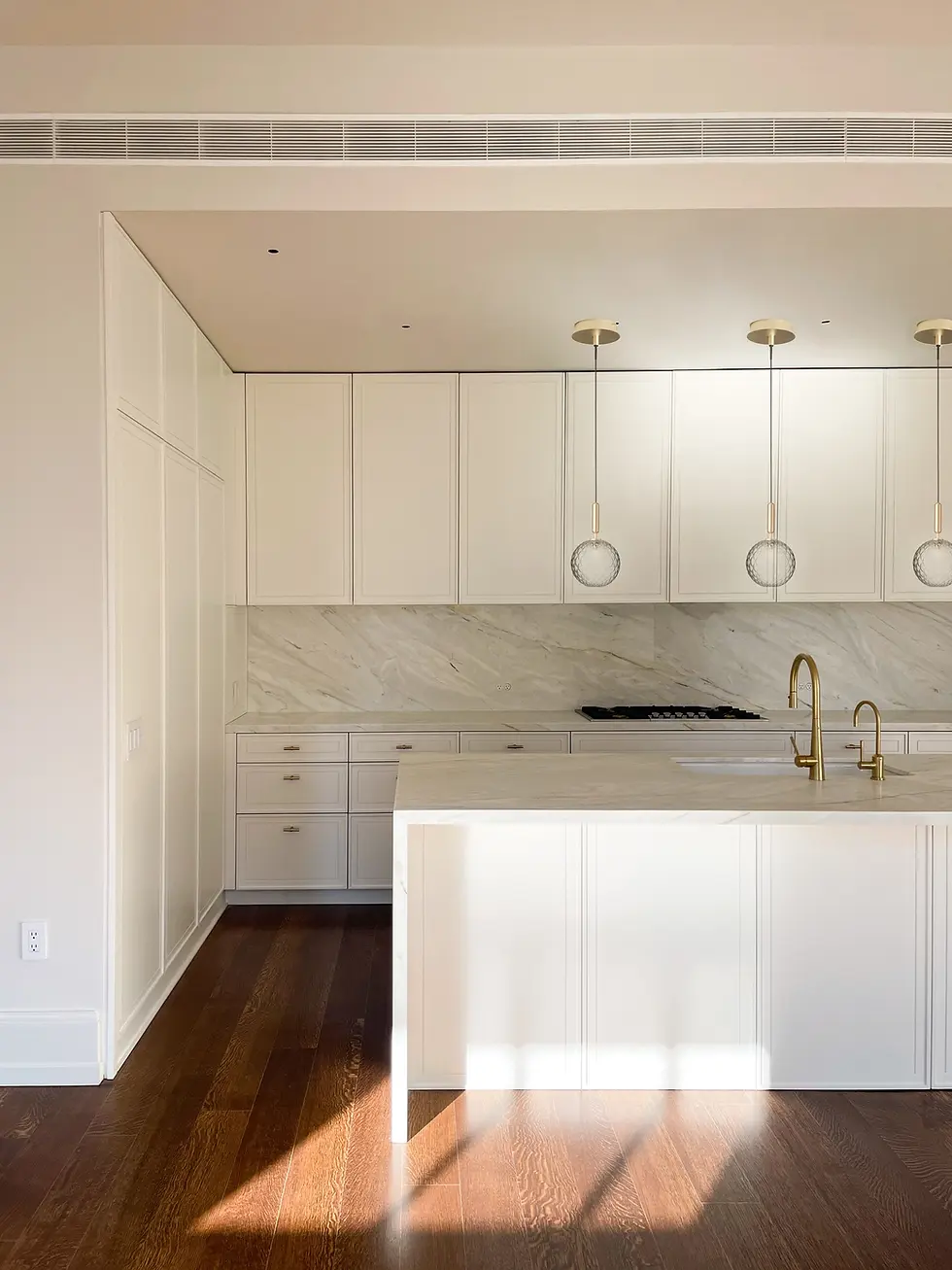
Appliances are often concealed within cabinetry, allowing the kitchen to read as a single composed surface rather than a collection of objects. Panel-ready refrigeration and integrated storage support this continuity, particularly in open-plan Brooklyn and Manhattan apartments where the kitchen is always in view.
In our West End Avenue apartment project, this approach becomes especially apparent. The kitchen is compact, yet everything is resolved within a continuous visual language. Storage, appliances, and preparation areas are fully embedded within the architecture of the room, creating a kitchen that feels calm and uninterrupted despite its density of function.
Pocket and swing systems are often introduced to allow the kitchen to shift in presence—fully open when in use, and visually quiet when not.

Layout as Proportion, Not Just Efficiency
Layout decisions shape how a kitchen is experienced spatially.
Cooktops are frequently preferred over full ranges in Manhattan kitchens, not only for practical flexibility, but also for the clarity they bring to the countertop plane. Separating the oven from the cooking surface allows for more intentional placement and a more refined composition.
Working space is always considered on both sides of key zones, particularly around cooking and preparation areas. This creates a sense of ease in movement that supports both everyday use and visual balance.
Kitchen islands often act as a central architectural element. In many Upper East Side apartments, where layouts are often shaped by pre-war proportions and more defined room divisions, the island becomes a shared surface for cooking, gathering, and interaction. In one project, seating was integrated directly into the island for the client’s use and concealed when not in use, allowing the kitchen to remain visually uninterrupted while still supporting moments of engagement.
In this kitchen, natural stone and dark wood-stained cabinetry define the atmosphere of the space. Instead of relying on contrast, the design is carried by material depth and proportion, allowing the kitchen to feel both grounded and expressive within the apartment.

Material as the Visual Structure of the Kitchen
Materials carry much of the identity of a kitchen. Countertops, in particular, become a defining surface. They are both working planes and architectural elements, shaping how the kitchen is perceived from adjacent spaces. Natural stone, engineered surfaces, and composite materials are all considered based on how they contribute to the overall composition as opposed to isolated performance alone.
Selection is guided by how a client lives, as well as how the surface will sit within the broader architectural composition of the home. Maintenance, tactility, and material aging are all considered as part of a longer view of the kitchen. In kitchen interior design across Brooklyn and Manhattan, countertops often become one of the most defining material decisions, shaping both the lived experience of the space and its visual clarity from adjacent rooms.
Materials are often selected from a restrained palette that prioritizes tactility, durability, and visual clarity. We frequently work with natural stone, valued for its timeless aesthetic and naturally textured quality. The material carries a quiet depth that works particularly well in kitchens where surface continuity and subtle variation are central to the overall composition. Cabinetry is treated with the same level of intent, favoring real wood veneers and lacquered finishes for visible surfaces, allowing texture and depth to remain present. We often incorporate wood veneer products such as Shinnoki ready-to-use veneered panels, introducing warmth and a refined contrast that complements the overall material palette without disrupting visual cohesion.
In parallel, Infinity Surfaces offers high-quality slabs with a refined, natural expression, more commonly used as a low-maintenance alternative to natural stone. The range supports a balance between performance and visual restraint, with options that allow for cohesive, uninterrupted surfaces. It is frequently used in kitchens across Brooklyn and Manhattan where the intention is to maintain visual continuity between the kitchen and surrounding living spaces.
Lighting as Atmosphere
Lighting plays a dual role in kitchen interior design. Task lighting supports the practical side of use, ensuring clarity where it is needed. Alongside this, ambient lighting shapes how the kitchen sits within the home when not actively in use.
These two conditions are designed together. A kitchen should function during activity, but it should also remain visually composed when seen from living or dining areas—particularly in Brooklyn and Manhattan homes where spaces are often fully connected.

Rethinking Kitchen Design in Brooklyn and Manhattan
Designing a kitchen in Brooklyn or Manhattan is an exercise in balance, but not between beauty and function as separate goals. Instead, it is about holding both within a single architectural idea.
At Studio Ocra, kitchen interior design is approached through material, proportion, and clarity of composition. Function is fully resolved, but never allowed to dictate the entire experience of the space.
A well-designed kitchen is one that feels intentional from every angle—equally capable of supporting daily life and contributing to the visual language of the home.


Comments